Monday, January 26, 2015

Matryoshkas


This lesson was inspired by the Patterned Matryoshka Dolls lesson from Deep Space Sparkle. Since I decided on the theme of "Asia" this school year it was perfect!This was a great lesson for teaching students about overlapping shapes, I also taught them a bit about light and shadow.

To prepare for the lesson, I printed out templates of a small, medium and big matryoshka on card-stock and cut them out. I tried to make one for each student. I also managed to buy some matryoshkas at my local World Market to show the students how they worked.

Class began with an review of the map of Asia so students could locate Russia and remember key facts about the country. I then explained to them what a Matryoshka was and who invented it. I showed them both matryoshkas I had bought and then shared this cute video from Sesame Street.


Before students started working on their matryoshkas I shared with them the story that inspired the original nesting dolls.


The students received the templates one at a time, from the smallest to the biggest. I showed them how to trace the templates correctly to create overlapping shapes using a recording I made.


When they were done I showed them some less traditional matryoshkas with superhero designs, animals, robots, etc. They picked a theme and got to work.


On the next class we discussed shadows and looked at some prints of paintings to identify light and shadow. Then I showed them how their shadows would look if a light was shining on their matryoshkas and how to use presure to create a dark and light shade with the same crayon/pencil. Then off they went to add colors and shadows.


Class time required: Two 45min. lessons

Lesson objectives:

  • We will learn about the history of Rusian nesting dolls or Matryoshka.
  • We will learn how to make shapes overlap.
  • I will draw three or more Rusian nesting dolls overlapping from the smallest to the biggest. 

Kindergarten:


First grade:


Second grade:


Fourth grade:


Kandisnky Inspired Abstract Paintigns


I searched far and wide for a Kandinsky lesson that wasn't based on his painting Squares with Concentric Circles and this is what I came up with.


Thursday, October 30, 2014

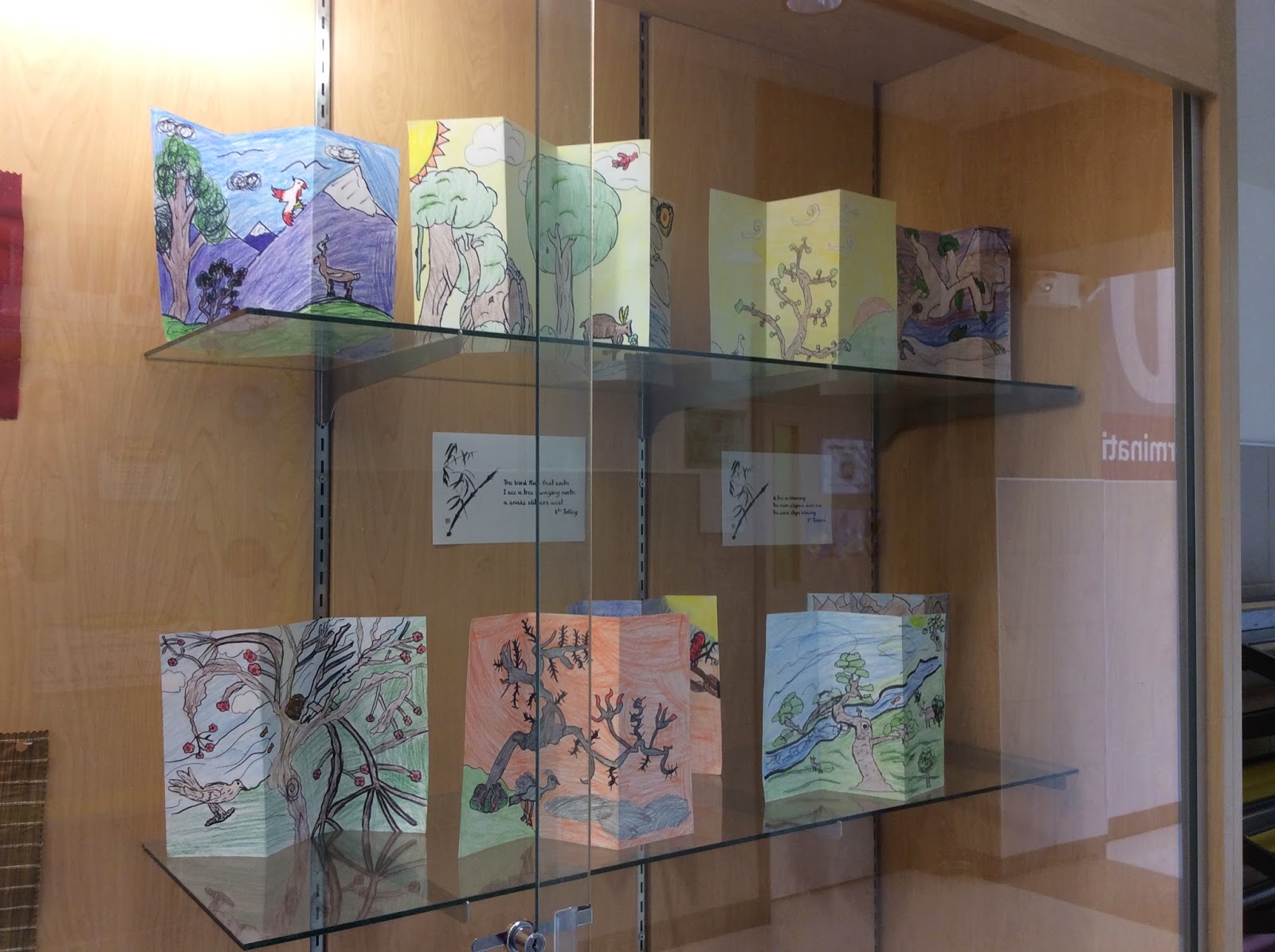
Mini Asian Folding Screens and Haiku Poem Lesson


 Lesson coming soon!


Kimono Art Lesson


We started the class by reading Suki's Kimono. I used the projector and camera so all the students could see the pictures and follow the story. I asked them some questions about the story, like who gave Suki her Kimono, why was it special, etc. 


I then explained to them the parts of the Kimono, the fact that I was wearing my Kimono helped!


The students then followed my instructions and drew their kimono outlines. I record myself drawing, then play it back and stop after each step so the students follow. We have a program that lets us remotely control the computer using the iPad, it's called Doceri. That way I can walk around and help and keep an eye on everyone. 


This is the video I recorded for my students. Then I instructed them to add patterns inside the Kimonos. They were drawing with markers, no pencils in my clasroom!


The last couple of minutes we danced "Under the big chestnut tree" since Suki shared a dance with her class. I showed them the moves before, and explained the lyrics, then we danced with the song.


Under the big chestnut tree,
you and me,
are playing happily. 

For the next class, they colored everything on their papers, starting with the pattern, then the kimono and last the background. We danced some more at the end of class.


Torii Gate Art Lesson


Visit All about Torii Gates for more awesome pictures
Torii Gates are found in Japan to identify the entrance to sacred places. Since I made a Torii gate out of paper in my class room I thought it would  be fun to have a lesson so students would understand what it is.

Torii gate in my classroom.


I started the lesson with this presentation, discussing the importance of Torii Gates and where they are found. Students observed and commented on the appearance, colors, etc. 


Students were very interested in the Torii Gate from Miyajima Island so I found a video that tours the island temple.


With all the information learned, and the images in their minds I showed students how to build a mini Torii Gate out of craft sticks. Each student needs 4. When they were done, we left them on the side to dry and started the mountain and the temple. The stairs were a bit tricky, but most of them got them right. I then let them add details to their landscape. Some asked if Godzilla was Japanese, so they added him to the drawing. Others remembered cherry blossom trees and added those, while others wanted to do a sea to imitate the Miyajima Torii Gate in the water.


Next class, they colored the Torii Gates since they were dry, and they were careful to only use colors real Torii Gates have: red/red-orange, brown (wood) or gray (stone). Once their drawings were colored, and their Torii gates dry and colored they glued them to the paper.


Some classes didn't have time to create a craft stick Torii Gate, so I showed them how to draw one instead.


Monday, September 15, 2014

Be art smART! ~ Art classroom rules.

Here are my very simple classroom rules, I have the kids read them out loud with me every time they come in my classroom. First thing we do is come in, sit down on the floor, read our learning statements and say our rules.

Art room rules

I made this my computer background so I just minimize all my open programs and we can read it together.

Happy art teaching!


Sunday, September 14, 2014

No paper art diagnostic test

I work at a school that had no art before I came, so I wanted to test the student's knowledge of art the first day of school. There are around 700 students and I see all of them. I didn't want to be making copies of a diagnostic test for all those students, and I sure as heck didn't want to grade them. What I  wanted was to know what the kids knew right on the spot.

Enter MRS (multiple response strategy) and a PowerPoint. All I needed was kids, a projector, a computer and my presentation. Zero papers to copy or grade. This is how it went:

  • I wrote down 10 things I thought my students should know about art concepts and turned them into multiple choice questions. I numbered the answers 1-3.
  • I made a PowerPoint presentation introducing myself ( what I liked, where I studied art, some of my drawings, etc.). I also included the class rules. Then in the same presentation I added the questions and the multiple choice answers. After each question I made a slide for the correct answer.
Letting them know we were going to take an art test. ;)
  • During class I introduced myself and the class rules. Next I told the kids they were going to take a test, the look on their faces was priceless. I explained it was a diagnostic test to see how much they knew about art concepts. I told them we would do the test together and we didn't need paper or pencil to take it. 
Question
  • The diagnostic test: I read the question out loud, then read the answers. I asked the students to put up one finger if they think one is the correct answer, put up two fingers if they think two is the correct answer, or put up three fingers if they think three is the correct answer. I gave them time to think for 5-7 seconds, and let them know everyone had to choose an answer in order to reveal the correct number. Tip: You can read the question one more time before revealing the answer. Repeat with the rest of the questions. Reinforce that they show you the answer not say it out loud.
Answer

  • As the students got the hang of it the pace increased, they would also be looking around to see who else had the same number up and encouraged everyone to participate so they could see the correct answer.
  • I looked around to see who had the correct answer, the signs and grunts let's me know who didn't get it right.
I hope this idea inspires you to try a new way of assessing student knowledge without making a paper and pencil test.

Happy art teaching!

~•~•~•~•~•••~•~•~•~•~•~•••~•~•~•~•~•~•~•~•••~•~•~•~•~•~•~•~•~•~•••~•

Here are some questions you can use for your test:
  • What line goes from top to bottom?
  • The primary colors are...
  • A triangle is a...
  • What materials would you use when making a painting?
  • Cool colors are...
  • Which of the following is a color wheel?
  • What is the first record of art made by humans?
  • A portrait is a picture of...
  • Which of the following is a gray scale?
  • Which of the following is a brayer?
  • What is a sketch?